2025-2026 Academic Catalog
Electrical Engineering, BS
|
|
 Return to: Undergraduate Studies Return to: Undergraduate Studies
Contact Information
Jeff McGough, Department Head
Electrical Engineering and Computer Science
Electrical Engineering/Physics 311
Phone: (605) 394-2722
Email: jeff.mcgough@sdsmt.edu
Department Website
Students are responsible for checking with their advisors for any program modifications that may occur after the publication of this catalog.
The Electrical Engineering (BS) program is accredited by the Engineering Accreditation Commission of ABET, https://www.abet.org, under the commission’s General Criteria and Program Criteria for Electrical, Computer, Communications, Telecommunication(s) and Similarly Named Engineering Programs.
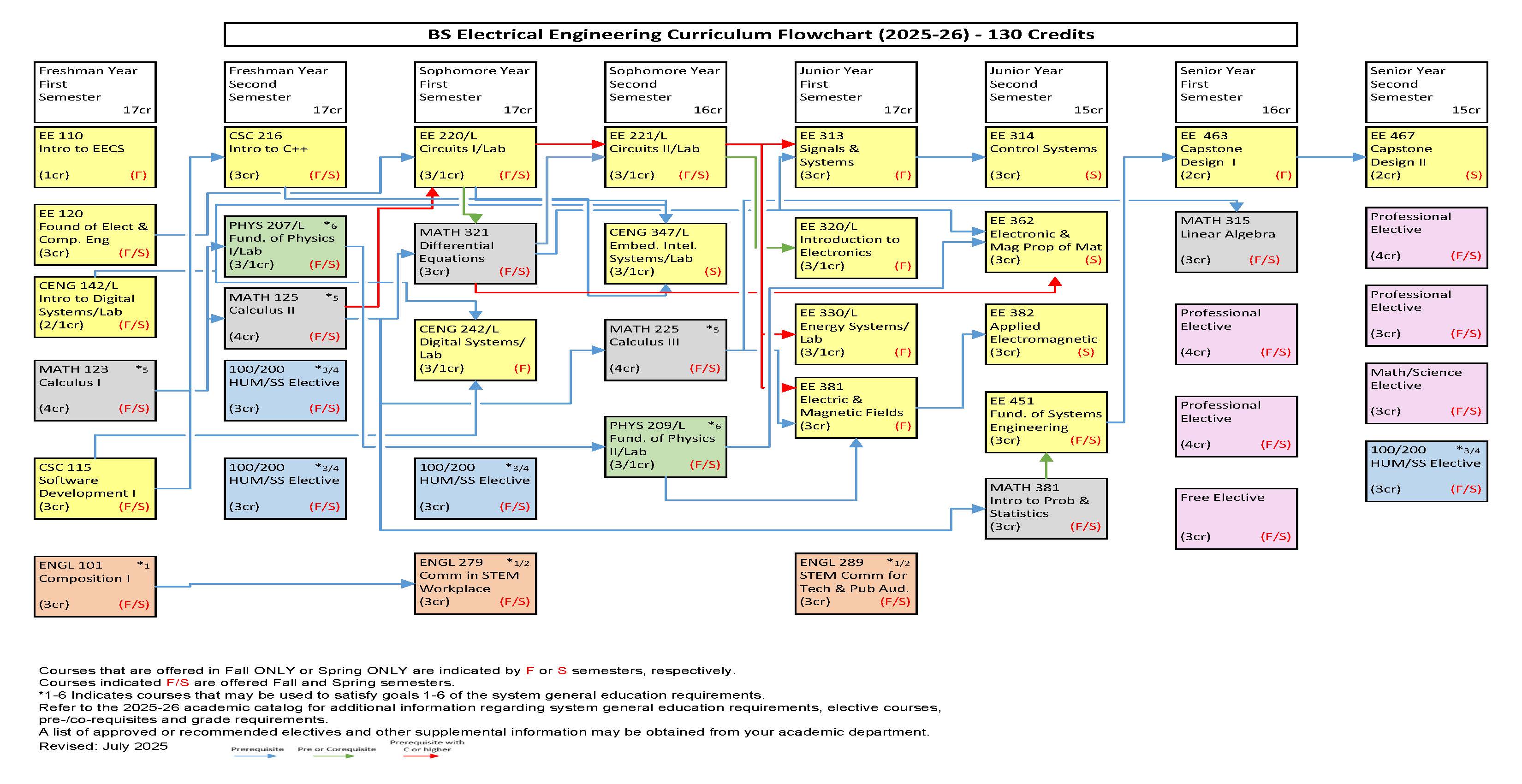
EE Flowchart
|
Second Semester
- EE 467 Capstone Design II Credits: 2
- Math/Science Elective Credits: 3 2
- Professional Elective Credits: 7 3
- General Education Goal 3 or 4 Elective(s) Credits: 3 1
Notes:
1 Fulfills General Education requirement. Students should consult the “General Education Requirements” section of this catalog for a complete listing of all general education requirements. 2 Select three credits from the following list: CHEM 112 ; MATH 251 , MATH 353 , MATH 373 , MATH 382 , MATH 415 , MATH 421 , MATH 432 , MATH 443 , MATH 447 , MATH 451 ; PHYS 225, PHYS 275, PHYS 331, PHYS 361, PHYS 421, or PHYS 451 3 Select 15 credits from any EE 4xx, 5xx, or 6xx courses with the exception of EE 451 , CENG 463/ CSC 463/ EE 463 , and CENG 467 /CSC 467 /EE 467 . Up to seven (7) credits from any other CSC or CENG 4xx, 5xx or 6xx courses may be used; one non-EE/CENG/CSC course at the 3xx level or above (four or fewer credits) may be included in this group of up to seven (7) credits if the student submits a written petition to their academic advisor which is then approved by the EECS faculty. Up to three (3) credits of CP 297/397/497 , EE 491 /EE 591 /EE 691 , and/or EE 498 may be used if the student submits a written petition to their academic advisor which is then approved by the EECS faculty. 4 A grade of “C” or higher is required in these courses for graduation with an Electrical Engineering, BS degree and/or for advancement into some subsequent required courses. Check prerequisite requirements on course descriptions. Objectives and Outcomes
Program Educational Objectives: - Graduates will successfully practice and advance in their careers in electrical engineering or related fields.
- Graduates will build on the fundamental and applied concepts they learned at South Dakota Mines via continuing education, certifications, graduate degrees, professional societies, and other similar enrichment activities.
- Graduates will effectively participate on or lead teams in diverse environments (e.g., work, professional organizations, community) responsibly, safely, and ethically.
Student Outcomes: - an ability to identify, formulate, and solve complex engineering problems by applying principles of engineering, science, and mathematics.
- an ability to apply engineering design to produce solutions that meet specified needs with consideration of public health, safety, and welfare, as well as global, cultural, social, environmental, and economic factors.
- an ability to communicate effectively with a range of audiences.
- an ability to recognize ethical and professional responsibilities in engineering situations and make informed judgments, which must consider the impact of engineering solutions in global, economic, environmental, and societal contexts.
- an ability to function effectively on a team whose members together provide leadership, create a collaborative and inclusive environment, establish goals, plan tasks, and meet objectives.
- an ability to develop and conduct appropriate experimentation, analyze and interpret data, and use engineering judgment to draw conclusions.
- an ability to acquire and apply new knowledge as needed, using appropriate learning strategies.
|
Return to: Undergraduate Studies
|

