| |
May 01, 2026
|
|
|
|
|
2025-2026 Academic Catalog
Data Science and Engineering, BS
|
|
Contact Information
Jeff McGough, Department Head
Electrical Engineering and Computer Science
Electrical Engineering/Physics 311
Phone: (605) 394-2722
Email: jeff.mcgough@sdsmt.edu
Department Website
Students are responsible for checking with their advisors for any program modifications that may occur after the publication of this catalog.
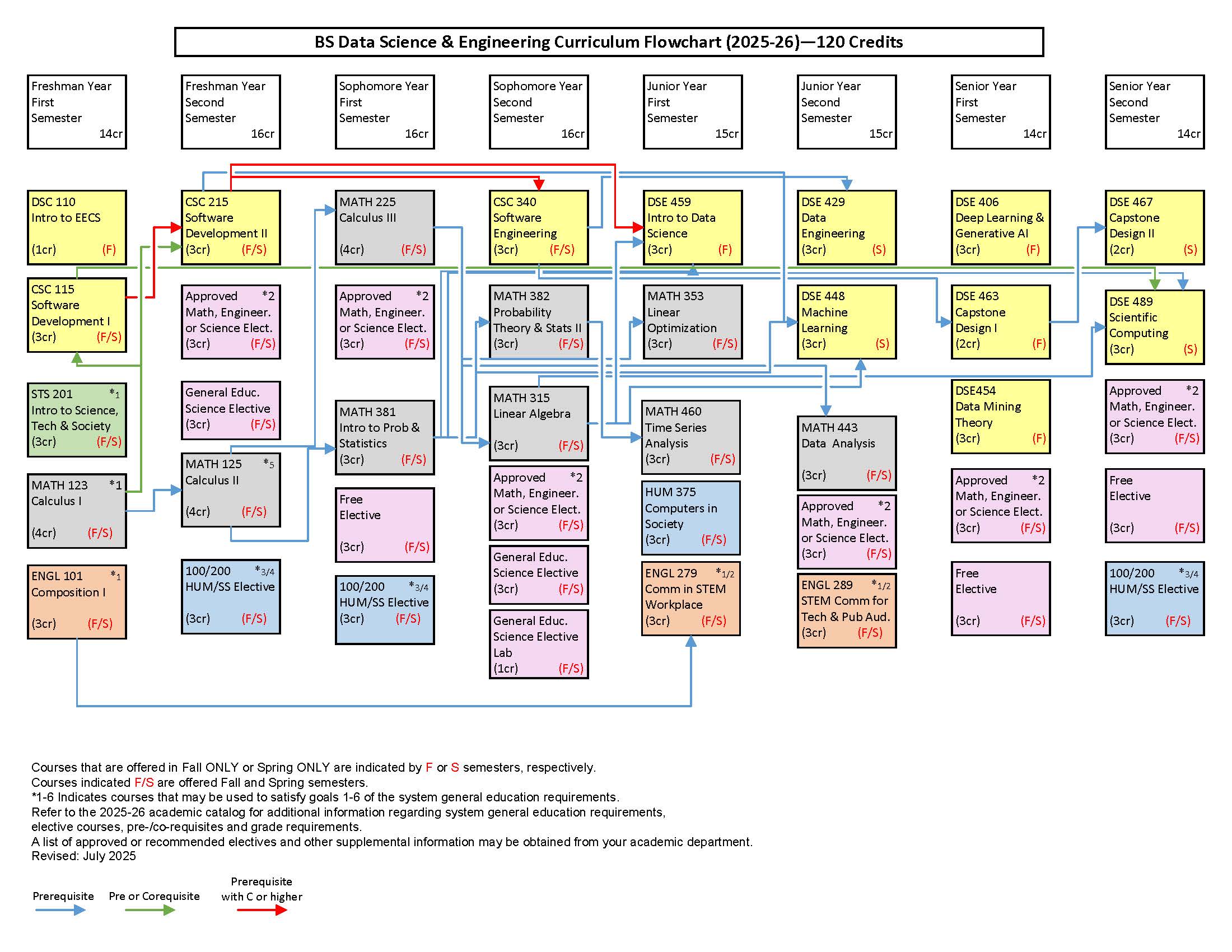
DSE Flowchart
|
Notes:
1 Fulfills General Education requirement. Students should consult the “General Education Requirements ” section of this catalog for a complete listing of all general education requirements. 2 Select 18 credits of math, engineering or science courses at the 2xx/3xx/4xx levels with a minimum of 12 credits at the 3xx/4xx levels approved by your advisor. Objectives and Outcomes
Program Educational Objectives: - Graduates will successfully practice and advance in their careers in data science and engineering or related fields.
- Graduates will build on the fundamental and applied concepts they learned at South Dakota Mines via continuing education, certifications, graduate degrees, professional societies, and other similar enrichment activities.
- Graduates will effectively participate on or lead teams in diverse environments (e.g., work, professional organizations, community) responsibly, safely, and ethically.
Student Outcomes: - an ability to identify, formulate, and solve complex engineering problems by applying principles of data science, computer science, and mathematics.
- an ability to apply data science and engineering to produce solutions that meet specified needs with consideration of public health, safety, and welfare, as well as global, cultural, social, environmental, and economic factors.
- an ability to recognize ethical and professional responsibilities and make informed judgments, which must consider the impact of data science in global, economic, environmental, and societal contexts.
- an ability to function effectively on a team whose members together provide leadership, create a collaborative and inclusive environment, establish goals, plan tasks, and meet objectives. an ability to communicate effectively with a range of audiences.
- an ability to develop and conduct appropriate experimentation, analyze and interpret data, and use professional judgment to draw conclusions.
- an ability to acquire and apply new knowledge as needed, using appropriate learning strategies.
|
|
|

